
The Fourth King.
You can read King Rehoboam’s story in 1 Kings 12-14 and 2 Chronicles 10-12
When I, Rehoboam, son of Solomon, travelled to Shechem for my anointing as King of Israel, I thought everything was in order. And then Jeroboam son of Nebat, scourge of the land, returned from exile in Egypt. He challenged my right to rule by demanding I lower taxes and lighten the labour laws. As if! It was only through the heavy taxing and harsh labour that my father could force these eternally vacillating people to build the LORD’s Temple.
I asked the old men of the land what to do, but they sided with Jeroboam! So I turned to my peers, who matched my thinking and suggested the labour wasn’t difficult enough. I took their advice and passed the message on to Israel.
The people revolted. When I sent Adoniram to deal with them, he was murdered. I mobilized my troops for war, but another of God’s ever-troublesome prophets called it off. Once Jeroboam constructed the gold calves, the people of Israel had no reason to visit Jerusalem and offer sacrifices. I was left with only the measly people of Judah and Benjamin to govern.
Under my rule, the legacy of great achievements that my father spearheaded fell flat. These good-for-nothing people accomplished nothing. The only thing they managed to build was more shrines. Five years into my reign, King Shishak of Egypt marched into my city and stole everything, including the Temple’s shields.
Thank the LORD, when I fell to my knees, He didn’t destroy everything I’d worked to achieve. Later, I replaced the gold shields with bronze ones. I couldn’t let the world see my Temple bare. Why couldn’t the people have just obeyed me? Was it because I hadn’t obeyed God?
Rehoboam, son of Solomon and an Ammonite woman, was the fourth (and final) ruler of a unified Israel. For the first time, we see genuine “evil” in a king, start to finish. Aside from a brief moment of remorse when faced with impending destruction, I couldn’t see any redemptive traits in Rehoboam. It’s sad to see that one wise decision could have spared Israel from all this trouble.
Throughout Rehoboam’s life, we see a common thread that weaves together as the Kingdom splits, Israel falls into idolatry, and the Temple is later looted. How did David’s grandson botch so much so quickly?
The Beginning.
“…Jeroboam and the whole assembly of Israel went to speak with Rehoboam.”
– 1 Kings 12:3
When Rehoboam’s story picks up, we find him in Shechem, about to be anointed King. Until Jeroboam resurfaces (see last week’s post). He hits on the brutality of Solomon’s regime: the forced labour and heavy taxes required to build the Temple and the King’s palace. Jeroboam calls for reform.
Rehoboam is at an impasse. Either he lowers taxes and labour demands so the people stay loyal, or he keeps things as is and risks rebellion. First, he consults the older counsellors (ironically, this is the one wise move he makes). These counsellors remind Rehoboam that if he’s willing to heed the people’s request, they’ll be loyal forever.
Rehoboam rejects their advice and asks his friends for feedback. Rehoboam had a serious trust issue and was unwilling to accept constructive advice. His friends flip the script and dial up the intensity, calling the Israelites complainers and suggesting Rehoboam say, “My little finger is thicker than my father’s waist!” (This has to go on the top ten indirect insults list.) Rehoboam listens to his friends, notifies the people that he will beat them with scorpions, and expects everything to blow over.
It doesn’t.
The Middle.
“So the king paid no attention to the people. This turn of events was the will of the LORD, for it fulfilled the LORD’s message to Jeroboam son of Nebat…”
– 1 Kings 12:15
After Rehoboam’s pronouncement, the Kingdom splits. Ten tribes side with Jeroboam and become the northern Kingdom of Israel. Judah and Benjamin remain with Rehoboam in the southern Kingdom.
Rehoboam attempts to restore order by sending Adoniram, but he’s killed. Then Rehoboam mobilizes his army to fight Israel, but the LORD sends Shemaiah to veto that idea. Rehoboam then realizes that neither Israel nor God is on his side. He begins fortifying Jerusalem and other various towns, bracing for the worst. Rehoboam trusted human protection over divine protection. He also marries 18 wives and accumulates 60 concubines. Compared to his father, that’s pretty tame.
While Rehoboam is trying to manage the loss of ten tribes, Jeroboam has a brilliant idea: Let’s build some gold calves so the people don’t have to leave Israel and worship the LORD in Jerusalem. (I imagine he read about Aaron’s attempt to appease the Israelites when they came to the brink of rebellion. See Exodus 32.)
As the northern Kingdom falls into idolatry, things don’t seem any better in Judah. Rehoboam doesn’t promote idol worship, but he does nothing to stop the people from building pagan shrines or setting up Asherah poles.
The End.
“In the fifth year of King Rehoboam’s reign, King Shishak of Egypt came up and attacked Jerusalem.”
– 1 Kings 14:25
Once Jerusalem is protected, Rehoboam officially abandons the Law of the LORD, trusting only in himself. God looks down from Heaven, snaps His fingers, and King Shishak invades. Rehoboam’s defences collapse, Judah’s treasures are looted, and everything is stolen, including the Temple’s golden shields.
In a brief moment of redemption, Rehoboam humbles himself and the LORD spares Jerusalem from complete destruction. God hears the cries of even the worst sinners. After this, Rehoboam replaces the Temple shields with bronze ones and calls it a day.
Quite evidently, Rehoboam is an evil king, for he didn’t seek the LORD with all his heart.
What Defined Rehoboam?
Here’s one of my takeaways from the fourth king…
~ Indifference is an Answer ~
“During Rehoboam’s reign, the people of Judah did what was evil in the LORD’s sight, provoking His anger with their sin, for it was even worse than that of their ancestors.”
– 1 Kings 14:22
If I step back and examine Rehoboam’s life, I see indifference written all over it. He was indifferent to the people’s request, indifferent to the wise counsellors, indifferent to God, indifferent to the people’s blatant sin, and indifferent to the holiness of God’s Temple. In other words, he didn’t care. Rehoboam only cared about protecting himself.
To avoid Rehoboam’s sin, we should do the opposite. We should care about other people (but not like the culture promotes, where we obsess about what they think). We should value good counsel and keeping people from sin. What matters to God should matter to us.
Good/Bad.
Rehoboam had indescribable potential, coming from Israel’s “Golden Age” under Solomon. Yet his indifference towards constructive advice cost him everything. From there, nothing changed as he sat in his fortified city and watched the world implode.
Which is why we need to put Rehoboam in his place on the Kings Chart…
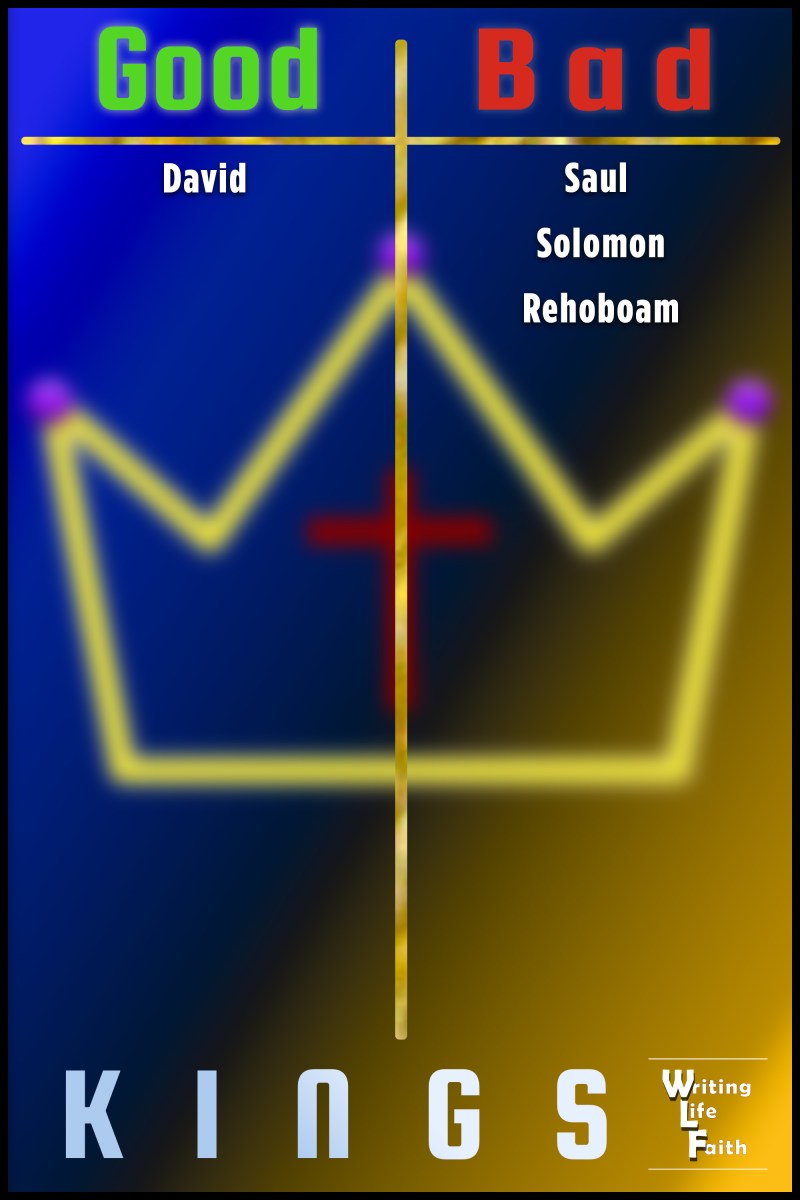
I for one don’t want to be like Rehoboam. Countless people go through life with no particular interest in what they do. Either they let themself be swept along, or they ignore what they know is right. Rehoboam was self-absorbed and lacked even a shard of his father’s wisdom. If only he’d read the Scriptures and Proverbs sitting at his fingertips. If only we regularly picked up the Scriptures and did likewise.
Things aren’t looking good for the Kingdom of Judah. Yet in 2 Chronicles 12:12 we see a flicker of hope, reminding us which God we serve…
“Because Rehoboam humbled himself, the LORD’s anger was turned away, and He did not destroy him completely. There were still some good things in the land of Judah.”




 Writing, Life, Faith
Drop a Comment